Sunday, August 18, 2013

Sea Stars

There are about 5,000 different species of Asteroidea or sea stars.
Sea stars usually have five arms, but some sea stars have forty arms.  Some sea stars lose their arms, but then a new arm grows back.  
A sea star has an eye spot at the end of each one if its arms.  They can only see light and dark.  
Sea stars move by using their suckers or "tube feet" on the bottom of them to move along the sea floor.    
Sea stars eat any small, slow-moving creature.  One place you can find sea stars is in shallow waters in oyster beds.  Sea stars stick their stomachs out of their body and eat their food. 

I want to catch them all!!!

This is a brittle star.  Brittle stars don't have a butt.  They poop out of their mouths.

This video shows you how a brittle star moves fast in the water.  


On this sea star there is an orange spot in the middle of its body.  That dot is called a sieve plate.  The sieve plate helps the sea star drink water.  There are little holes, that you can't see, in that dot.  The water goes through those holes into its arms.  


Loggerhead Sea Turtle

Loggerhead sea turtles eat hard things, like horseshoe crabs and soft things, like jellyfish.  They can live up to 50 years old.  They can travel thousands of miles.  They go back to the same beach that they were born at to lay their eggs.  The eggs hatch 60 days after the mom laid them in the sand.  Lots of them get eatten by predators.   Loggerhead's are not endangered but are threatened.  I wish I could see a real loggerhead sea turtle.

This is part of a loggerhead's shell and rib cage.  This bone was found in the saltwater pond by Long Point Beach in Martha's Vineyard.  You can also find blue crabs at this pond.

This is a loggerhead sea turtle eating a conch under the water. 
http://seaturtles.org/article.php?id=1251

This is a little baby loggerhead walking toward the ocean.

http://wwf.panda.org/what_we_do/endangered_species/marine_turtles/loggerhead_turtle/

Horseshoe Crabs

Horseshoe crabs are not true crabs.  They come from sea going spiders.  Horseshoe crabs have been around before the dinosaurs were around, 400 million years.  They look scary, but they will not hurt you.  They eat worms, clams, and dead fish.
They lay hundreds of eggs in each hole.  They lay thousands of eggs in total.  Many get eaten. 
Before horseshoe crabs are three years old, they have already shed their shell 11 times.  After that, horseshoe crabs shed their shells once a year when they get too big for their old shell.  I found tons of baby horseshoe crab shells.  
Sometimes horseshoe crabs swim upside down.  They use their gills to swim by moving around.
They have blue blood.  Doctors use it for medical stuff.  
To learn more watch this video at: http://m.youtube.com/watch?v=e8KlAmtIu1E&desktop_uri=%2Fwatch%3Fv%3De8KlAmtIu1E

I like to find horseshoe crabs at Stonewall Pond.  

This is a horseshoe crab shell, but it does not have its tail.

A horseshoe crab's front shell is shaped like a horse's hoof.  


Martha's Vineyard

This summer we went to Martha's Vineyard.  We went looking for sea creatures.  My favorite place to go is Menemsha because there are lots of crabs there.  Unfortunately, we did not catch any fiddler crabs.  I had a great time, and I can not wait until next time.

Wednesday, August 14, 2013

Skate Egg Case

This blog post is about skates and how they are like or different from rays and sharks.  Sharks, skates, and rays are like cousins.  Skate fish are flat and wide like a sting ray.  Skates live in cold water, and rays live in warm water.  Skates and rays don't have any bones.  They have cartilage like sharks.  Rays can grow up to 35 feet and skates can only grow up to 8 feet.  Rays are more active than skates.  Skates and rays eat clams and other small things.  They use their teeth to break shells and eat the inside of it.  Skates don't have barbs on their tails for stinging, but they have small spines and can give a small shock.  Skates and sharks have eggs that look almost the same, but rays give birth to live rays.

This is a picture of a fishman at Menemsha holding a skate.  


In this picture the two outer small black egg cases are skate egg cases.  The middle might be a skate egg case, but it might also be a shark egg.  I am pretty sure it is a shark egg case.  

This is a picture of a skate egg case with a baby skate in it.  The egg the case is bigger than this 12 inch ruler.  The egg cases shrink one-third of their size when they dry.  
http://www.coralreefinfo.com/coralglossary/glossary_e.htm

This is a baby skate hatching out of its egg case.  
http://aquariumofthebay.org/pages/detail/442

In this picture, you can see that the cownose ray has teeth.  

http://www.globio.org/glossopedia/article.aspx?art_id=47#


Monday, August 12, 2013

Fiddler Crabs


Fiddler crabs use their bigger claw to talk to each other.  They make noises with their claws and legs to talk to each other.  Fiddler crabs move their claws in patterns to communicate with other crabs.  Fiddler crabs from other beaches might not understand a fiddler crab from another beach.  I think we could not catch them because if one crab came out he could communicate with other crabs, telling them we were there trying to catch them.  The fiddler crabs were in their holes because they could feel us stomping through the path.  

Thursday, August 1, 2013

Mole Crabs

Yesterday Amanda, my little brother, my cousins, my aunt, and I went to Stonewall Beach to look for mole crabs.  We found sixty-two mole crabs.  We dug in the sand next to the water to find them.  When the water came in, tons of mole crabs would come in the hole and bury in the sand.  Then I would swoop them up in my net.  It was such an exciting time.  


This is me holding a mole crab in my hand.

This is me dumping the bucket of the mole crabs in the sand.  Look closely.  There are mole crabs burying themselves in the sand.  


The mole crabs have back legs that help them swim. 


Kayaking at Stonewall Pond

Today my family and I went kayaking and paddle boarding at Stonewall Pond.  We went snorkeling to look for different sea creatures.  We caught a blue crab, a spider crab, tons of brittle stars, a lady crab, some hermit crabs, two horseshoe crabs, and a whelk.  I liked everything about this day!    

This is us going to the shore with our nets and our buckets.


This is the blue crab we caught.

This is a boy blue crab.  You can see it has a line at the bottom.  This blue crab has paddles on his back legs just like a lady crab.  


This is the picture my brother, my cousin, and I holding a live horescrab. 


This is two horseshoe crabs.  The big black one is a boy and the small one is a younger girl.  


Crabs Caught in the Summer of 2013


This is a bar graph of the crabs that we have caught during tutoring.  Most of the crabs that we caught were mole crabs.  We caught them all in one day.  We also caught a lot of green crabs and asian shore crabs.  We caught zero fiddler crabs and only one rock crab.  


Crabbing at Menemsha

On Tuesday Amanda, my Mom, Matt, and I went to Menemsha to go crabbing.

This is a spider crab.  

In this picture, I am under the dock behind the ice cream shop.  

These are two green crabs

This is a black-fingered mud crab. 

Here is Grey sticking his hands in the rocks.  He is one brave boy.

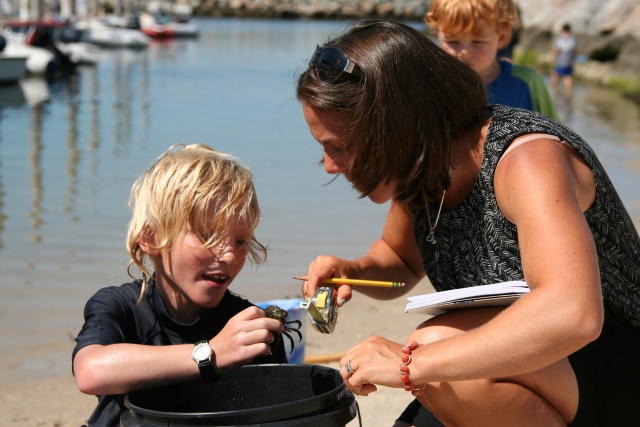
In this picture we are measuring crabs.


I caught twenty-one crabs.  Most crabs I caught were one inch.  The least amount were three inches.


At Menemsha a big green fishing boat pulled up.  It had rays and flounders.  The rays were for lobster bait.

It was fun to have my Mom there.  


On Tuesday my friends and I also went boogie boarding at Stonewall Beach.  

Barnacles

Barnacles are in the crustacean family.  Barnacles have feelers or legs that catch food.  They grab the food and suck it in.  Barnacles stay in one place for their whole lives.  They live on anything that is hard that they can attach to.  Some barnacles attach themselves to whales.  

Pelagic Goose Barnacle

This is me opening a goose barnacle, so you can see the feelers or legs.  


Bay Barnacle 


Amanda found this at Long Point Beach. This is a log with a bunch of barnacles on it. 


Wednesday, July 31, 2013

Using a Crab Trap

This week Amanda and I used a crab trap to catch crabs at Menemsha.  First we went to Larsen's Fish Market to get fish scraps.  We used the fish guts and stuff for bait.  Then we went to the bridge and tied the fish guts onto the trap.  They were slimy and disgusting.  Normally I use squid for bait, but this time I used smelly fish guts.  After you open the trap, you drop it into the water.  Then you wait for a little while.  If the water is clear, you can see them crawling into the trap.  If there is a crab in the trap and one crawling to the trap, wait until the other one crawls in.  The one in the trap will stay there because he will eat the fish.  Then you can pull it up really fast, so they don't get away.  I caught five crabs.  I had a great time.  

This is me with my crab trap, but the crab trap does not have any bait in it.


This is a video of me tying on bait, near the bridge where we are going to go crabbing.

This is a picture of me pulling my crab trap up.  


I caught one crab in this picture.

This is a picture of me holding two crabs, one spider crab and one female green crab. 

This is me dropping in my trap.


This is me looking in the water for crabs crawling in my trap.

This is a picture of me holding a boy green crab.  


Getting Stung by Fire Ants

This weekend I got stung by tons of fire ants at the pond.  My friends, my mom, and I were about to let the frogs we caught go when I accidentally stepped on a fire ants nest.  I was jumping up and down as they bit me with their jaws.  There were tons of them on me.  They were mostly on my left leg.  I kicked them off of me.  I hope it never happens again!  

Friday, July 26, 2013

Frog Hunting

On Thursday my cousins and I went looking for frogs at Duartes Pond.  I whacked a bush with a net and a big bullfrog came out.  I swooped him up with my net.  Then I put him in a bucket.  We also caught five baby catfish, three tadpoles, one froglet, and a lot of frogs.  It was fun hanging out with my cousins.  

This is a picture of some of my cousins and me catching some frogs.  I am the one with the brown shirt on with a net catching a frog.


This is me holding a net trying to catch a frog.

This a green froglet. 


This is a green frog.

This my mom holding the green bullfrog that I caught.  The bullfrog in this picture was not that jumpy.